Sunday, February 14, 2016

Little Big Man: Warner Wolf and Andre the Giant

One of the biggest names in sport -- from one of the biggest men ever to play a sport -- owes a lot to the little guy. (Scroll down to see the whole interview).

"Andre the Giant" was born Andre Roussimoff in 1946 in Grenoble, France.  Most Americans know of him from his WWF days in the 80s (and his role in The Princess Bride) -- though at that point he was 40 years old, overweight, and suffering from alcoholism and other health problems that would lead to his death in 1993.  But take a time machine back to the 1960s and 70s, and you could see his showmanship on full display to audiences in Europe and Japan.  Check out these amazing photos from when he was truly at his physical peak.

So why was the little man (Warner Wolf) so important to the big man (Andre the Giant)?  In the 1970s, wrestling was not nationally organized, but a loose confederation of regional circuits.  If you lived in, say, Atlanta, you only got a chance to see wrestlers from the Georgia Championship Wrestling (check out this map of regional wrestling organizations that were all independent at the time).  The comedian Andy Kauffman's foray into professional wrestling only became public after the fact, because his matches were only broadcast locally in Memphis, Tennessee.

If you wanted to follow a phenomenon like Andre the Giant, who was outside of your geographical area, you were out of luck... unless you could watch Warner Wolf's sports highlights.  Unlike many of his prominent sportscaster colleagues, Warner regularly included wrestling in his TV highlights -- in Washington in the 1970s, New York in the 1980s, and nationally on the CBS Morning News.  Listen to this recollection of wrestling podcaster Don Tony, who attributes much of wrestling's early nationwide success to Warner Wolf.

The below interview is a perfect example.  On March 31, 1975, the Capital Centre was hosting a wrestling card featuring Andre the Giant -- who was so popular at the time, that his parent organization regularly "loaned him out" to all the regional circuits to promote his popularity.  Warner Wolf, then the sports anchor for WTOP-TV in Washington (now WUSA), obviously considered it a newsworthy local event, having shown Andre's highlights on numerous broadcasts.  Andre's showmanship was on full display, making jokes about having "too many girls," and picking up Warner with one hand at the end of the interview.  (For the record, Andre and Bruno Sammartino defeated the tag-team champion Valiant Brothers by disqualification).

By 1986, when Warner rebroadcast the clip on the CBS Morning News, wrestling had consolidated its regional circuits into a singular organization called the WWF, with Andre as one of its superstars.  A year later, at Wrestlemania III in Detroit, Andre fought Hulk Hogan in front of the largest audience ever at an indoor sporting event.  A year after that, he was immortalized as Fezzik, the friendly giant, in The Princess Bride.  And a year after that, Andre's image became a pop art sensation that still sells today.  And the WWF (now the WWE) has since become a nationwide media conglomerate, worth more than half a billion dollars.

The local-news interviews, smiling and waving at the end, seem quaint by comparison.

Yet without the little guy, the big guy wouldn't be nearly as big.

Let's go to the videotape!

Originally filmed March 31, 1975

Rebroadcast February 21, 1986

Monday, February 1, 2016

Battle of the Sexes in Tennis: A Short History

On this date in 1986, Warner Wolf asked Chris Evert (then the 2nd-ranked female tennis player in the world) if she could beat the 100th-ranked male tennis player in the world.  Her answer: no way. (Scroll down to see the whole interview).

The "Battle of the Sexes" motif in tennis has a rich and colorful history.  Men and women have played mixed doubles tennis together at the professional level since the 1920s (and even earlier in the United States).  It seems natural that athletes' competitive spirits might compel the occasional scrimmage between men and women, but no notable event had ever been organized until 1973.  Bobby Riggs (who had won championships in the 1940s) had such disdain for women's tennis, he claimed that, at 55 years old, he could still beat the top-ranked female tennis player at the time, Margaret Court.  The match, which took place on Mother's Day, saw Riggs defeat Court 6-2, 6-1.

Emboldened by this sudden publicity, Riggs upped the ante by challenging all other prominent female tennis players with a $100,000 bounty for whomever could beat him.  Billie Jean King accepted the challenge, and the event now known as the "Battle of the Sexes" took place in Houston's Astrodome, complete with Cleopatra-style entrances, commentary from Howard Cosell, and other gimmicks.  King's victory over Riggs was witnessed by 90 million television viewers -- still the largest TV audience ever for a tennis match, and at the time, the largest TV audience since the moon landing.  

In 1985, Riggs (then 67 and in ailing health) revived the "Battle" format, recruiting a doubles partner in men's champ Vitas Garulaitis.  Garulaitis picked up the chauvinist gauntlet, claiming that even the 100th-ranked male player could easily beat the number-1 female player.  Despite this, in the match itself, Riggs and Garulaitis lost to top-ranked Martina Navratilova and Pam Shriver (coincidentally, a distant cousin to Warner Wolf's co-host, Maria Shriver).

Without context, Chris Evert's comments might have seemed to bolster those who subscribe to Riggs' brand of chauvinism.  In truth, her response is logical and pragmatic -- all things being equal, if a top-ranked male player competed against a top-ranked female player, the male player would likely win.  Indeed, subsequent male-female "Battles" (Connors vs. Navratilova in 1992, Karsten Braasch vs. the Williams sisters in 1998, or Djokovic vs. Li Na in 2013) have been less about confrontation and more about entertainment.  Indeed, the legendary 1973 match is more cultural touchstone than sporting event; it will soon become a feature film starring Emma Stone and Steve Carell.

What 2016 sports spectators have learned is that men and women don't need to compete with each other physically to be successful.  Women's sports -- particularly tennis -- are surging in popularity, and many female athletes are achieving financial and cultural success on par with their male colleagues.  Women are making names for themselves as soccer players, mixed-martial-artists, coaches and referees.  The 1973 "Battle of the Sexes," once the largest-attended tennis match of all time, was surpassed by 2010 event in Belgium featuring... wait for it... women's tennis champs Kim Clijsters and Serena Williams.

What remains to be seen is whether women will one day compete in sports where they are, indeed, on equal footing with their male counterparts (such as they do today in NASCAR and horse racing).  Can mixed competitions in bowling, curling, sailing, and the e-sports of the future be far off?

Let's go to the videotape!

Where Are They Now?

Plays of the Week: February 14, 1986
  • 0:14 It's hard to overstate how momentous the decision was in 1986 for the IOC to allow "professionals" to compete in the Olympics.  The previous head of the IOC, an American named Avery Brundage, held fast to the original Olympic ideals of amateurism -- making the 1980 "Miracle on Ice" that much more meaningful, since the US hockey team that defeated the Soviets were almost entirely college students.  However, the die was truly cast by 1992, when the NBA allowed its players to compete in the Olympic basketball competition, and the first "Dream Team" was born.  In America, "amateurism" is now largely spoken with a giggle -- even in the NCAA, where the concept of paying college players is seriously on the table.  To answer Warner's questions: 1) Would the NHL interrupt its season to allow its stars to skate in the Olympics?  Answer: yes (though the owners still don't like it).  2) Who pays a star if he gets injured in the Olympics? Answer: the owner does.  This was recently highlighted by a horrific injury to NBA star Paul George during a international friendly.  The Pacers still paid his salary, but it did bring up a discussion of who is profiting most from this current mix of professionalism and amateurism.
  • 2:11 Stadium geeks might be able to pinpoint exactly when Warner's Yankee Stadium dream was filmed, but we know it was after 1976 renovations that replaced the old wooden seats with plastic ones. The 80-year-old Yankee Stadium was torn down in 2009, replaced by a new Yankee Stadium costing more than $2.3 billion.
  • 3:15 Warner celebrated the NHL's foray into videotape replay, but it was the NFL that first used replay in 1986 to supplement official calls (NHL in 1991; NBA in 2001; College football in 2004; Tennis in 2006; MLB in 2008; Soccer in 2014!)  In the coming months, we'll have much more to say about the use of replay as Warner sees it in action throughout 1986.
  • 3:46 Hard to believe, but in 1986 Spud Webb's teammate Dominique Wilkins had never even seen the 5' 7" Webb dunk before.  This sandbagging helped to cement Webb's legacy after he defeated Wilkins to win the 1986 Slam Dunk Contest.  His victory was relived twenty years later, when he threw a bounce pass to 5' 9" Nate Robinson, who jumped over Webb as an homage to win the 2006 contest.  Webb also appeared in the 1995 film Forget Paris, where 5" 7" Billy Crystal (playing an NBA referee) famously told him, "You're the only one I can talk to."
  • 4:00 Isaiah Thomas also appeared in Forget Paris -- as well as in the 1989 and 1990 NBA Finals, in which he and Dumars and the rest of the Detroit Pistons gained their forever reputations as the "Bad Boys."
  • 4:09 The Golden State Warriors were in a bit of a slump in 1986.  It took until 2015 for them to bring an NBA championship to the Bay Area -- exactly 40 years after their previous championship.
  • 4:29 Alexis Arguello, "El Flaco Explosivo" ("The Explosive Skinny Man"), was a 3-time world champ. After knocking out Billy Costello in 1986, he didn't fight again except for two brief comeback fights in the 90s.  He instead turned to politics in his native Nicaragua, where he won the mayoral election of the capital, Managua, in 2008.  Amidst allegations of corruption and political retribution, Arguello was found dead a year later, of an apparent suicide.  Though a statue in his honor was erected in Managua, many people still think foul play was involved.
  • 4:35 Scott Stevens became known for his hard hits while on the Washington Capitals, being named one of their top 40 players of all time.  But Stevens actually played more years in New Jersey, where he became the first player to have his number retired in Devils history.
  • 4:45 Gord Dineen was the definition of "journeyman," playing for 13 major and minor league hockey teams.  Dave Brown, at the receiving end of those 8 left hooks, delivered his own blow a year later -- breaking the jaw of Tomas Sandstrom, and meriting a record 15-game suspension.

Friday, January 1, 2016

Remember When the New England Patriots Were the First to Admit to Wrongdoing?

On this date in 1986, Warner Wolf talks about the New England Patriots being the first NFL team to publicly admit wrongdoing.  Also, the Plays of the Week features basketball brawls between 7-footers, hockey brawls that are now catalogued online, and a football brawl involving a Colombian kicker and his mother.  Let's go to the videotape!


The New England Patriots weren't always perceived as cheaters.  The legend began at the infamous Snowplow Game in 1982.  When the Patriots lined up for the game-winning field goal in a blizzard, snowplow operator Mark Henderson, a prisoner on work release, plowed a clear spot for the holder to place the kick.  Opposing coach Don Shula cried foul, and even refused (on moral grounds) a similar opportunity to plow the snow for their own field goal attempt.

Thus began a pattern for New England Patriots football.  Through cleverness and gamesmanship -- and skirting the edges of legality -- the Patriots always find a way to gain an advantage over their opponents.  While fans and players of other teams cry foul, Patriots fans revel in their ingenuity.  In fact, the snowplow from that 1982 game is proudly on display at Patriot Place.

However, this pattern took an unfortunate turn in January 1986, after the Patriots lost to the Chicago Bears in Super Bowl XX.  In a surprise move, Coach Raymond Berry chose the Monday after the Super Bowl to admit to the media that many of his players had struggled with drug abuse. Reacting to this shocking news so soon after the big game, many fans had the knee-jerk reaction of blaming the Patriots' loss on drug distractions -- you can imagine a similar outcry on social media if the incident happened today.  Only later did the facts come to light: seven out of their 50 players tested positive for cocaine and marijuana before the season, and none tested positive during gamedays.  Still, the Patriots themselves so felt the impact of the problem that they became the first NFL team to independently volunteer for drug testing.

Warner's "Boo of the Month" addresses the subsequent response of the NFL Players Association, who immediately denounced the move, and filed charges against the Patriots to stop it.  In 1986, Warner took a black-and-white stance on drugs, saying that playing professional sports is a privilege, and "if a player's not willing to keep his part of the bargain, then get another job."  The Players' Association, however, feared that the Patriots' unilateral move would put all teams and players in jeopardy.  Likewise, unilateral moves by the NFL to institute a league-wide drug-testing policy were also shot down, and even contributed to an NFL players' strike the next season.  It wasn't until 1990 that the Players' Association and then-new NFL commissioner Paul Tagliabue were able to negotiate a successful drug-testing protocol.

What went unsaid in 1986 -- and what we can only know in hindsight thirty years after the fact -- was how drastically all parties underestimated the scope of drug abuse in professional sports.  Indeed, even commissioner Pete Rozelle believed that drug use was on the decline in 1986, based on anonymous opinion surveys of players at the time.  Only later did the overwhelming influence of steroids and performance-enhancing drugs begin to overshadow concerns about cocaine and marijuana.  A casual fan in 1986 might recoil at reading the roll of disgraced athletes who have since been busted due to drug abuse: olympic sprinter Ben Johnson, whose 100-meter gold medal was rescinded; Raiders linebacker Lyle Alzado, who believed his terminal brain cancer was caused by two decades of drug abuse; baseball sluggers Mark McGwire, Sammy Sosa, and Barry Bonds, who each broke home-run records while on steroids; WWE wrestler Chris Benoit, who committed suicide after killing his wife and son, with a testosterone level 10 times normal; cyclist Lance Armstrong, who won the Tour de France seven times before admitting to doping; pitcher Roger Clemens, who was among 89 MLB players named in a Congressional investigation in 2007.

Today, even with increasingly lax societal attitudes toward drugs, professional sports leagues have tightened the lid on drug abuse by athletes.  Offenders are punished in stages, but also offered treatment and rehabilitation.  Guidelines are publicly available, as are lists of offenders.  It's no longer a grand shock when players admit to drug abuse; it's merely Step One of a story toward redemption.

So be thankful that, in the 21st century, the Patriots only have to deal with accusations regarding spy cameras, odd formations, or deflated footballs.

Where Are They Now?

Plays of the Month: January 31, 1986


  • 0:55 Herb Williams, who made that 81-foot shot for the Indiana Pacers, was traded three years later for Detlef Schrempf.  He never played on a winning team until landing with the New York Knicks, where he was a player, assistant coach, and interim head coach.  He now is an assistant with the WNBA's New York Liberty.
  • 0:55 How about those baby blue Sacramento Kings uniforms!  It was great news when they brought them back for 2015
  • 1:07 Dan Roundfield, or "Rounds", was near the end of his illustrious career when he missed that dunk for the Washington Bullets.  He died tragically in Aruba in 2012, drowning in an attempt to save his wife.
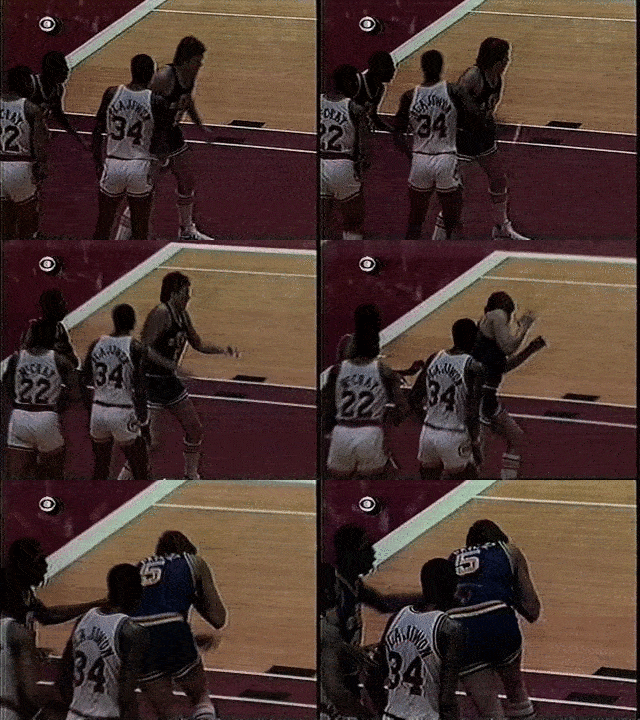
  • 1:41 The fistfight between David Dunn of Georgia and Kenny McClary of Florida was big news in 1986.  Though the fight started with Florida's Vernon Maxwell and Georgia's Patrick Hamilton (who were both ejected), David Dunn got the worst of it, requiring three stitches afterwards.  Dunn ended up playing basketball overseas, and even tried out for Buddy Ryan's Philadelphia Eagles, before becoming a high school and college coach in Georgia.  Kenny McClary, who also played basketball overseas, is the stepfather of current NBA star Trevor Ariza.
  • 1:49 Certainly the two tallest players ever in an NBA brawl, 7' 7" Manute Bol and 7' 0" Jawann Oldham both had memorable NBA careers and notable activism internationally.  Bol advocated for his native Sudan until his death in 2010, and Oldham helped to found basketball leagues in Korea, China, and Dubai.
  • 1:55 It's also interesting to note the fines that Warner mentions after these NBA fights.  While the amounts may have changed, the biggest difference in the past 30 years is the emergence of social media.  Check out what NBA players are being fined for today -- for making comments, for using inappropriate language, or for criticizing the refs.  It seems that in the Twitter era, players and coaches are more likely to be fined for what they say, rather than what they do; for example, in September 2015 the NBA fined Markieff Morris $10,000 for "a public statement detrimental to the league," when he tweeted his desire to be traded.
  • 2:10 Mark Johnson, who went blue-line-to-blue-line on the highlight reel, is a veteran of the 1980 "Miracle on Ice" Olympic hockey team.  He went on to coach the US Olympic women's team in 2010, and now coaches at the University of Wisconsin in his hometown of Madison, where his daughter Mikayla is a starting forward.
  • 2:21 Well-matched hockey fighters Pat Verbeek and Marc Bergevin are now both NHL general managers -- Bergevin with the Canadiens, and Verbeek with the Lightning (as an assistant to his former teammate Steve Yzerman).
  • 2:28 Warner loved showing hockey fights, like the Leafs-Red Wings tussle on January 13, 1986.  But thanks to 30 years of technology advancements, the details of every hockey fight in history have now been meticulously catalogued!  Check out the hockeyfights.com page for this particular battle.
  • 2:42 It's understandable why Dolphins kicker Fuad Reveiz and Patriots linebacker Don Blackmon might have had a dust-up. A month earlier, Fuad kicked the winning field goal to beat the Patriots in their penultimate regular season game, meaning the Dolphins had home-field advantage for the AFC Championship rematch.  When Fuad missed a 31-yarder in that game, Blackmon taunted him, and Colombian-born Reveiz did not back down.  Blackmon reported that he merely said, "Good kick, Fuad," while Reveiz claimed that Blackmon "questioned my mother's profession." 
  • 2:50 What did the above slap and Ronnie Lippett's Super Bowl hit on Jim McMahon have in common?  No flags were thrown, and no fines were levied for either incident.  Try getting away with that in today's media-churned NFL.
  • 3:10 Larry Nelson, who hit that chip shot out of the water, has had an incredible career.  But read this Golf Digest story where Larry talks about serving in Vietnam, leading search-and-destroy missions during the Tet Offensive!
  • 3:18 Every so often a sports highlight reel will show a horse like "Tribute to Ted," who wins a race after shedding its jockey (no surprise, since they're 100 pounds lighter than the competition).  But could this actually be the future of racing? It already is in the Middle East, where racing camels are now remotely directed by robots, from the comfort of an air-conditioned suite.
  • 3:27 Boxer Greg Haugen gained his first of two world titles in December 1986.  He is best known for his 1993 fight against Julio Cesar Chavez in Mexico City -- the most-attended fight in boxing history, with 132,000 spectators.  Haugen had made some not-too-flattering comments about Mexicans before the match, and as a result, the ring was surrounded by a moat and barbed wire!
  • 3:34 In 1986, Hulk Hogan was at the height of his popularity, in the middle of his 4-year reign as WWF Heavyweight Champion.  Macho Man Randy Savage would later claim the title himself in 1988, only to lose it a year later to Hogan at Wrestlemania V.  30 years later, both are also well-known for their activities outside the ring.  Hogan showcased the insanity of his family in a regrettable reality show; while Savage faced off against Spider-Man and became inexorably linked to Slim Jims, before his death from cardiac arrest in 2011.

Tuesday, December 1, 2015

Plays of the Year from 1985: Animated and Annotated

For a sports fan, 1985 was an interesting year.  The teams you followed were likely your local teams, and you watched their brief highlights on your local 11:00 news broadcasts.  ESPN was still an oddity, one of only 30 cable networks in existence (and only rich people had cable!)  You might see Wide World of Sports on the weekend, or perhaps syndicated TV specials from NFL Films, or Mel Allen's This Week in Baseball -- but otherwise, most of us got our sports fix by reading the newspaper.

Enter Warner Wolf, and the birth of the sports blooper reel.  A sports anchor on New York's WCBS, Warner's TV segments largely focused on local teams, like the Mets and Knicks -- but every Friday he also compiled the best highlights from all teams in all sports, calling them the "Plays of the Week."  A typical segment might include amazing plays from the major leagues, but also odd plays and bloopers from obscure college and high school sports, as well as boxing or wrestling.  Warner injected the presentation with true vaudeville, gearing up his audience with his signature catchphrase, "Let's go to the videotape!"  He'd tease the subjects of the bloopers ("Nice catch, Eric!") or, if the players were running toward the camera, he'd warn the audience ("Boom, into your living room!")  Even the background music, a dixieland song called "That's a-Plenty", is an homage to Jackie Gleason, who used to kick off his show with his own signature catchphrase: "And awaaay we go!"

Today's sports fan takes for granted that "best of" sports highlight reels are served up every night, catchphrases a-plenty, delivered to mobile phones and social media accounts on demand.  But Warner's "Plays of the Week" was so unique and popular in the early 1980s, that the CBS Morning News (also broadcast from New York) would welcome Warner every Friday morning for a nationwide showcase of his videotapes and his special perspective on sports.  By 1985, many imitators had followed suit; George Michael pushed buttons on his Sports Machine, Bob Uecker trawled the public domain for his Wacky World of Sports, and Marv Albert brought his Albert Achievement Awards to David Letterman.  My local sportscasters called their segment the "Highlight Zone."

But Warner was the real deal -- and not just because he was the first to do it in an entertaining manner.  Having covered sports since the 1960s, he also had a critical historical perspective.  When one-armed pitcher Jim Abbott gained baseball notoriety in the 1980s, Warner showed films of Pete Gray, who played left field with one arm in 1945.  If other sportscasters hailed the rough-and-tumble Detroit Pistons as NBA's "Bad Boys," Warner would roll an interview with Celtics hall-of-famer Sam Jones, who in the 1960s had threatened to break the kneecaps of Wilt Chamberlain.

That's why, starting in 1985, I followed Warner's lead in compiling my own highlight reel -- preserving Warner's "Plays of the Week" segments on VHS tape.  Now, 30 years later, we can watch these sports time capsules with our own historical perspective.  Hulk Hogan being fake on TV, before fakeness on TV became a virtue.  Manute Bol getting into a fight, before Celebrity Boxing.  The New England Patriots admitting to wrongdoing.

Every week, we will share Warner's "Plays of the Week" TV segment from exactly 30 years ago, discussing the issues that were relevant then, and remain relevant today.  We will provide "Where Are They Now?" links to some of the more notable names and faces mentioned in the highlight reel.  We'll even follow up on some of Warner's co-hosts (whatever happened to that Maria Shriver?)  And of course, your memories and perspectives are always welcome.

We begin with Warner's "Plays of the Year" for 1985.  Let's go to the videotape!


Where Are They Now?
Plays of the Year: 1985
  • 0:05 The Milwaukee Bucks played in the MECCA Arena until 1988.  Leaving aside how the name of the arena might ruffle a few feathers today (MECCA stands for Milwaukee Exposition Convention Center and Arena), the floor itself became a coveted objet d'art, as told in this ESPN 30-for-30 short.  Today, the Bucks actually change their court for certain games to match their new black uniforms.
  • 0:23 Michael Jackson, who slid into fame while playing basketball at Georgetown, eventually became president of the YES Network, and now is VP of Global Basketball at Nike.
  • 0:28 After the Florida State-Louisville brawl, four players were ejected -- but not Herb Crook, whom Warner complimented on his "nice placekick."  In fact, Crook went on to score the game-winning layup as time expired!
  • 0:52 Alpine skier Klaus Gattermann (of what was then called West Germany) survived this horrific crash in Kitzbuhel, Austria, but was no longer willing to risk his life on the fast downhill courses.  He now works for German ski manufacturer Völkl.  In the thirty years since then, Kitzbuhel has claimed many victims; read this terrifying list of injuries suffered at the most dangerous downhill course in the world.
  • 1:00 Think that Michael Adams falling-out-of-bounds shot is impressive?  Look at how Adams shot his free throws.  He remains one of the few NBA players in the modern era to embrace the push shot (Shaquille O'Neal doesn't count), as Adams became an All-Star and played in the league for 11 years.
  • 1:06 The longest basketball shot in history, an 89' 10" hook shot by Bruce Morris of Marshall, is immortalized by green footprints that remain on Marshall's home court to this day.  Check out these current players attempting to duplicate the feat in his footsteps.  Since a basketball court is 94 feet long, and the basket is set 4 feet in, this record will likely never be broken.
  • 1:13 Dr. J retired in 1987, while Mo Cheeks eventually coached the 76ers. Sadly, 21st-century Philly fans have become so acquainted with losing, the only way they could break an NBA record 27 consecutive losses was by reliving 30 years ago with throwback uniforms and nostalgic tribute nights.
  • 1:26 Name a golfer today who shows as much flair and enthusiasm as Chi Chi Rodriguez, who lit up the golf world with his toreador putter/sword celebration (here he demonstrates how to do it properly).  1980s TV fans might also remember him from the sitcom WKRP in Cincinnati, where Les Nessman always mispronounced his name.
  • 1:49 Clothesliner Micheal Ray Richardson played in the NBA for 8 years, and in Europe for another 14 years.  In the first ever season of the National Basketball League of Canada in 2011, he became the head coach of the London Lightning, who won the championship with Richardson being named Coach of the Year.
  • 2:01 In the Orlando Renegades' colorful USFL history, Mike Guess' butt-wiggle might have been one of the few highlights; under head coach Lee Corso, the team never had a winning season.  Interesting fact: the team was brought to Orlando by a businessman named Donald Dizney (no relation to the Mouse or the Duck!)
  • 2:08 For what it's worth: in the battle of "coolest" boxers, Norberto Sabater defeated Bill Lee by split decision after 8 rounds.
  • 2:45 Hakeem "The Dream" Olajuwon's sucker punch of Billy "The Whopper" Paultz may have been a lowlight of The Dream's career, but it was a highlight of Paultz's final year in the NBA.  Read this hilarious retrospective of how Jazz coach Frank Layden had to replace injured superstar center Mark Eaton with Billy Paultz, telling him to get under Olajuwon's skin.  Spoiler alert: it worked, and the Jazz upset the Rockets in the first round of the playoffs.
  • 2:51 Irate goalie Kelly Hrudey, after playing 15 years in the NHL, became a broadcaster for CBC's Hockey Night in Canada.
  • 2:56 What an amazing 21st century we live in.  The hockey fight between Ed Hospodar and George McPhee is one of thousands that have been catalogued at dropyourgloves.com, including punch counts, descriptions, video clips, and judges' scorecards! (Reviewers called this one a draw).
  • 3:12 Marvin Hagler vs Thomas Hearns, which only lasted three rounds, is still considered one of the finest boxing matches in history.  Hagler, after losing a similarly enormous "Fight of the Year" to Sugar Ray Leonard in 1987, never fought again; Hearns won several titles through the 80s and 90s, finishing in 2006 with a record of 61-5-1.  Fun fact: Hagler loved his nickname so much, he legally changed his name to Marvelous Marvin Hagler.
  • 3:44 Minor-league umpire Denny Cregg, who was clobbered by Mike Hart, has another claim to fame. He umpired the longest professional baseball game in history: a 1981 minor-league marathon in Pawtucket, Rhode Island, featuring 8 1/2 hours, 33 innings, and no bathroom breaks!  The game also featured 80s superstars Wade Boggs, Cal Ripken Jr., and Bob Ojeda.
  • 3:59 It's somewhat shocking to see Robert Parish -- someone so stoic, his nickname was "The Chief" -- punch another player in the face.  But if anyone could rile him up, it would be Bill Laimbeer, whose physical play was so notorious, he even had his own video game called Bill Laimbeer's Combat Basketball.  Both also are well-known for their longevity; Parish played more regular season games than anyone in NBA history, over an incredible 20 years.  Laimbeer has now coached longer than he has played; he has won three titles leading the WNBA's Detroit Shock and New York Liberty.
  • 4:05 Alabama native Joey Jones stayed close to home, not only catching this amazing touchdown for the USFL's Birmingham Stallions, but becoming head coach for the University of South Alabama's first football team in 2008.  Perhaps more notable from this clip: sure it gets hot in Alabama during the summer, but USFL referees wore shorts?!?
  • 4:13 Bullfighter Jose Manzanares passed on his dangerous profession to his son, Jose Maria -- who hedged his bets this year by also becoming a fashion model for Dolce & Gabbana.
  • 4:58 Where does the karate kick by George Bell rank among baseball fights?  Is it better than Chan Ho Park's leaping kick in 1999, or Izzy Alcantara mule-kicking the catcher in 2001? Either way, in 1987 Bell became the only Blue Jay to win an MVP award -- until Josh Donaldson in 2015.
  • 6:29 Mike Scioscia, now the longest tenured manager in Major League Baseball, had his fair share of collisions as a major league catcher.  Those collisions are now history, since blocking the plate became illegal in 2014.
  • 6:42 Boris Becker is still the youngest man to win Wimbledon; the youngest female was Maria Sharapova (also 17) in 2004.  The youngest overall major winners?  Michael Chang (17) at the 1989 French Open, and Martina Hingis (16) at the 1997 Australian Open.  For the record, Serena Williams was 2 weeks shy of her 18th when she won her first major, the 1999 US Open.  Also for the record: tennis players can join the professional Seniors Circuit at age 35!
  • 6:52 For young people watching the highlight of Ken Griffey's "catch of the year," keep in mind that it was Ken Griffey Senior.  Junior was a high school freshman at the time -- although he would make his own bevy of spectacular catches after his MLB debut four years later.
  • 7:03 Von Hayes might have biffed on that catch, but he had already made history that year by becoming the first MLB player ever to hit two home runs in the 1st inning of a game.  The feat has been achieved four more times in the last 30 years -- two of them by brothers Bret and Aaron Boone! 
  • 7:24 Yogi Berra's son Dale played in the majors for 10 years, but might be best remembered as the second person tagged out in succession by Carlton Fisk, in a play Yankees manager Billy Martin said he'd never seen "in grammar school, let alone the major leagues."  It's worth mentioning that Fisk, who played 24 years as MLB catcher, didn't block the plate -- meaning the play would still be legal under today's stricter rules (see above).
  • 7:40 Today's generation knows Ed "Too Tall" Jones from this Geico commercial.  But 1980s aficionados might also remember him from an episode of Diff'rent Strokes, where he's sent out onto a window ledge to rescue Arnold, only to discover that "Too Tall" is afraid of heights!
  • 7:45 Does the name "Norberto Sabater" ring a bell?  He's the "cool" boxer Warner highlighted earlier.  This knockout from Iran Barkley was Sabater's second-to-last bout.
  • 7:58 Warner makes a mistake describing the sliding catch by a third baseman; Wade Boggs was not involved.  The catch was made by Blue Jays 3rd baseman Rance Mulliniks, who robbed Dwight Evans of the Red Sox.
  • 8:32 Earl Weaver would only manage the Orioles for one more season before retiring.  He and fellow Hall-of-Famer Stan Musial died the same day, January 19, 2013.
  • 8:38 As the Colts had just moved to Indianapolis a year earlier, punter Rohn Stark holds an interesting place in NFL history: the only player to play in the era of both the Baltimore Colts and the Baltimore Ravens.  Video gamers also know Stark from 1991's Tecmo Super Bowl, in which the punter was the best statistical player on the lowly Colts roster.
  • 8:45 Yes, that's Giants defensive coordinator Bill Belichick receiving an "impromptu cold shower" from linebacker Harry Carson.  Could this be the first recorded Gatorade shower?  Read this comprehensive history and decide for yourself.  For all the showers he got as a Giants assistant coach, Belichick successfully avoided Gatorade showers after his first two Super Bowl wins with the Patriots in 2002 and 2004.  He did get dunked in 2005, and even got two dunkings in 2015.
  • 8:50 Tennis great Yannick Noah, father of current NBA star Joakim Noah, is often credited with inventing the "between the legs" shot (though he is only its most famous practitioner).  He did, however, invent a shot called the Jump Smash.
  • 9:13 Ozzie "The Wizard" Smith developed his famous backflip as a kid, playing with his friends in a lumberyard.  The best front flip in baseball history has to be this 2010 highlight from Fordham University.
  • 9:21 "Spike it, Willie!" Refrigerator Perry certainly made the most out of his 1985 rookie year, running for a touchdown against the Packers, and later doing the same against the Patriots in Super Bowl XX.  Within a year, he had also guest starred on the A-Team, rapped on the Super Bowl Shuffle, participated in a Royal Rumble at Wrestlemania 2, been immortalized as a GI Joe action figure, and received the largest Super Bowl ring ever made.  Unfortunately, the Fridge had to sell his ring to pay for multiple medical issues later in life.  It also bears pondering that Warner calls Perry "the biggest running back in football history"; today, at 308 pounds, Perry would rank as midsize, even on a college football team.  He's also no longer the heaviest player to score in the postseason; 337-pound Packers nose tackle BJ Raji ran back an interception for a touchdown in the 2011 NFC Championship.
  • 9:30 Football H-style goalposts used to sit on the goal line, making them even more dangerous than this collision.  But the policy to move them back to the end line in the 1970s wasn't made for safety reasons; it was because soccer-style kickers were too accurate in their kicks, making the game less exciting for the fans.  (In 2015, the NFL again tried to address this accuracy "problem," moving extra points back from the 2-yard line to the 15.) As for colliding tight end Scott Helverson, he stayed in the game as a referee, working as a back judge in two Super Bowls.
  • 9:38 South Carolina quarterback Mike Hold and receiver Raynard Brown had an amazing 1984 season -- the best in South Carolina history to that point.  Unfortunately, 1985's campaign was pretty forgettable, save for this one "play of the year"; it was the team's only score in a 42-7 loss at Pitt.
  • 10:15 Craig Hodges certainly knows his way around a long-distance shot; in 1991, he set a Three-Point Shootout record, hitting 19 in a row.
  • 10:31 Does this John Stallworth catch remind you of another famous Steelers circus catch, 10 years earlier?
  • 10:39 Clemson fans still remember the backstory to this brawl: Maryland beat Clemson for the ACC Championship on a last-second touchdown catch in which the receiver clearly did not hang on to the ball.  Tigers players took out their frustrations on Maryland's Lewis Askew, who had nothing to do with the play.  Meanwhile, Clemson coach Danny Ford took out his frustrations on the officials, leading to an unprecedented instance for the 1986 rematch in which both head coaches were banned from the game.
  • 10:47 Phil McConkey had served a full four-year hitch in the Navy before being signed by the Giants as a 27-year-old rookie, specifically to catch punts (Tom Landry once said that McConkey could catch a punt "in a rock slide.")  He became a folk hero for his efforts in Super Bowl XXI a few months later, where he ran back punts and caught a touchdown pass.   Military academies loosened their rules in 2008, allowing athletes to pursue athletic goals before their active duty commitments.
  • 10:51 Ken Stills is proud of his role in the Packers/Bears rivalry, but is not particularly proud of this extremely late hit against Matt Suhey, which took place during Ken's first ever NFL game.  Check out this YouTube comment where Ken apologizes for his poor sportsmanship.
  • 10:58 See something else flying, other than side judge Bill Quinby's arms as he fell down?  This is the infamous "Snowball Game," where Denver fans pelted the field with snowballs -- one of them disrupting a San Francisco field goal attempt, ultimately costing them the game!
  • 11:10 Vinny Pazienza, who went on to gain 5 world titles after a life-threatening car accident, is being portrayed on the silver screen by Miles Teller in an upcoming film called "Bleed for This."  For the record, Paz's opponent (Melvin Paul) only fought once more after this knockout.
  • 11:17 Ainge-to-Bird-to-McHale, 30 years later, would involve an NBA president-to-president-to-head-coach. [UPDATE: McHale was fired last week. C'mon Kevin! Become president so you can complete the fast break!]